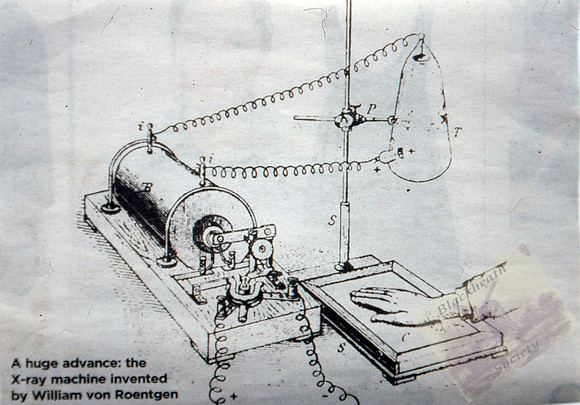
An early X-ray machine invented by W. Roentgen. Webster's experiments and demonstrations of this new technology contributed to the early death of Webster in 1910.
Webster was the son of
William Webster, a successful building contractor who grew wealthy from constructing major civil engineering and building projects in London. The family lived from 1869 in Wyberton House in Lee Terrace, Blackheath.
Webster was a pioneer in
x-ray research and a founder member of the
Röntgen Society (since 1927 part of the
British Institute of Radiology), assisting surgeon Thomas Moore in producing radiographs in 1896, after which Moore set up an x-ray unit at the
Miller General Hospital in
Greenwich High Road.
Webster is also believed to be the first person to experience radiation 'sunburn', suffered on his right hand. He wrote a letter on the subject of x-ray photography published in the journal
Nature in 1897.
Webster was an accomplished violinist, singer, and artist - his paintings were exhibited in the Summer Exhibition at the
Royal Academy. In 1881 local residents formed the Blackheath Conservatoire of Music, and Webster founded the company which funded the building of a concert hall, today
Blackheath Halls, and its neighbouring schools for art and music, the
Blackheath Conservatoire. The Conservatoire of Music opened in 1896 and the School of Art in 1897.